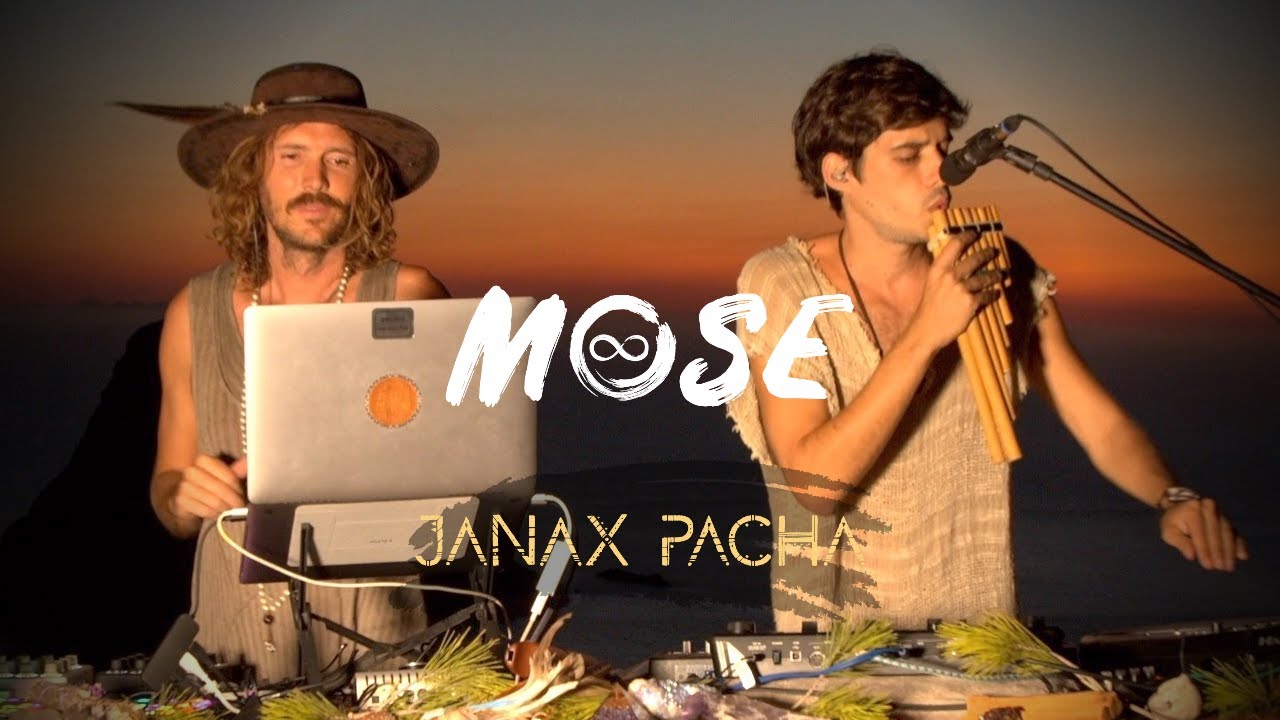
Mose's Reveries is a 64-minute live electronic set that layers remixed tracks with spoken-word excerpts from Eckhart Tolle's The Power of Now, creating a sonic environment designed to deepen awareness of presence, embodiment, and the eternal present moment. The mix emerged from a 2-month retreat and uses looped instrumental phrases to anchor reflections on sensory awareness, surrender, the dissolution of ego-time, and unity consciousness. Rather than background music, it functions as a guided meditative experience—each musical transition supporting Tolle's core teaching that the now is the only reality that exists.
What does it mean to use your senses fully in the present moment?
Tolle's opening instruction in the mix sets the foundational practice: "Use your senses fully. Be where you are. Look around. Just look—don't interpret. See the light, shapes, colors, textures." This is not passive observation but radical sensory presence. Most of human consciousness is filtered through thought, memory, and expectation—the mind naming, labeling, and judging what it perceives. Tolle is proposing that direct sensory contact with reality exists prior to thought.
When you see without interpretation, you notice qualities that the thinking mind usually glosses over: the particular grain of light on a surface, the texture of silence between sounds, the subtle rhythm of breath. Mose's choice to weave this instruction over looped instrumental passages reflects this practice sonically—the listener is invited to hear the production elements (filtered basslines, sustained pads, layered synths) not as carriers of a concept but as objects of pure attention, the way you might notice the texture of cloth or the temperature of air.
The practice extends to internal sensation. Tolle continues: "Feel and acknowledge the being of" whatever you observe—the unnamed aliveness in a shape, a sound, a moment. This begins the collapse of the boundary between observer and observed. You are not separate from the light and color you notice; you are aware within them. The electronic textures in Reveries support this dissolving—layered, ambient, lacking the clarity of traditional song structure, they create a perceptual field rather than a focal object.
How does the concept of "the now" differ from clock time?
Tolle distinguishes sharply between psychological time (past and future, memory and anticipation) and the eternal present. He teaches that suffering, anxiety, and the sense of incompleteness arise from attention split between what was and what might be. "The more you are focused on time—past and future—the more you miss the now, the most precious thing."
This is not romantic sentiment but a diagnosis of consciousness itself. When you are planning, regulating, defending, or mourning, you are in time—the dimension where the ego, the constructed self, lives and maintains itself. The now, by contrast, is the only moment in which you can act, feel, or live. "The eternal present is the space within which your whole life unfolds. The one factor that remains constant. Life is now. There was never a time when your life was not now, nor will there ever be."
Clock time has value for logistics—scheduling, prediction, cause and effect. But the belief that your life is divided into past (what you cannot change) and future (what you must achieve) leaves the present empty, a mere doorway to somewhere else. Tolle locates being itself in the now: "Feel the power of this moment as the fullness of being. Feel your presence." To feel presence is to stop postponing your life. Mose's extended instrumental sections, without verse-chorus-bridge structure, create a temporal space that resists narrative progression—they ask the listener to dwell rather than arrive.
What is the "inner body" and how does it connect us to being?
Tolle uses the phrase "inner body" to mean felt aliveness within the physical form, prior to thought or body image. "The body that you can see and touch cannot take you to being, but that visible and tangible body is only an outer shell, a distorted perception of a different reality." The true body is not the shape you see in the mirror but the sensation of life animating it.
"In your natural state of connectedness, this deeper reality can be felt every moment as the invisible inner body—the animating presence within you. To inhabit the body is to feel the body from within, to feel the life inside the body, and thereby come to know that you are beyond the body form."
This is not dualism—not spirit escaping matter—but rather a shift in how you know yourself. You are both the biological organism and the awareness that inhabits it. Most people experience only the outer shell: the shape, the image, the narrative ("I am strong," "I am unwell," "I am young"). The inner body is the current of vitality flowing through sensation, breath, and presence. It has no story, no improvement arc, no future. It simply is alive.
In the context of a chill set, this teaching invites the listener into embodied listening. You are not thinking about the music or what it means; you are feeling its vibration, the frequency moving through your chest, the rhythm organizing your breathing. The music becomes a carrier of the inner body's presence—not entertainment but an environment in which you remember you are alive.
How does surrender relate to accepting the present moment?
Late in the set, Tolle addresses the most difficult teaching: "If there's truly nothing you can do to change your here and now and you can't express yourself in the situation but then except you're here, and totally by the faults of the happy self that loves feeling miserable, resentful, or sorry for itself—connect. No longer times this is surrender."
Surrender is often misunderstood as passivity or resignation. Tolle means something precise: the cessation of internal resistance to what is. If you are in pain, the pain is present. If you are afraid, fear is present. The secondary suffering arises from the mind's rejection of the fact—"This shouldn't be happening," "I can't accept this," "This is unfair." That resistance is an attempt to change the past or prevent the future, both of which are impossible. It only generates additional suffering.
Surrender means: "Yes, this is what is true right now. I am aware of it. I am not pretending it away or fighting it in my mind." From this place of acceptance, paradoxically, change becomes possible. "In surrender there is great strength in it, always. The render passes, and spiritual power. Soon surrender, you will be free, internally, on the situation. You will then find that the situation changes without any effort on yourself."
The dynamic of the set mirrors this teaching. There is no climax, no resolution, no moment where things "get better." Instead, the music unfolds as it is, and the listener is invited into acceptance of each phrase, each texture, each moment exactly as it appears. This is the opposite of entertainment-as-escape; it is entertainment as a practice in being.
What does unity consciousness mean beneath physical forms?
Tolle returns repeatedly to a single statement: "Underneath the level of physical appearances and separate forms, you are one with all that is." This appears early and is restated near the end of the set, suggesting it is the culminating realization. It deserves unpacking.
The human experience of separation—"I am here, the world is there, other people are separate from me"—is real at the level of form and psychology. But underneath form, at the level of being itself, there is no division. The awareness that reads these words is not inside your head; it is what the head and these words appear within. The same awareness, the same "isness," animates all form.
This is not philosophy but a direct claim about experience. When you drop into presence—beyond thought, beyond the body image, beyond the narrative of self—you encounter an aliveness that has no boundary. It is not "my" awareness; it is the awareness that appears as the experience of being alive. Trees, other people, animals, clouds—all are expressions of the same reality, temporarily organized into different forms.
Tolle also speaks of a "profound transformation that is taking place in the collective consciousness of the planet—the awakening of consciousness from the dream of matter, form, and separation; the ending of time." He is suggesting that this shift from ego-consciousness to presence is not individual enlightenment but a species-level event. Reveries participates in that shift by creating sonic space where it becomes possible to taste unity, to release the grip of separation, to recognize your life as an expression of one life appearing in infinite forms.
What is the "one step" of the inner journey?
Tolle offers a teaching on the structure of spiritual work: "Your outer journey may contain a million steps. Your inner journey only has one step: you're taking it right now. As you become more deeply aware of this one step, you realize it already contains within itself all the other steps, as well as the destination. This one step then becomes an act of great beauty and quality. It will have taken you interfering and the light of being will shine through it. This is both the purpose and the fulfillment."
The spiritual path is often imagined as a long ladder. You are here (asleep, unenlightened, incomplete), and there is a destination (awakening, peace, realization) that requires many steps to reach. This is the ego's way of thinking—it projects fulfillment into the future. Tolle is saying: the entire journey is available now, in this moment, in your presence right here.
Each moment, fully inhabited, contains the whole path. When you are fully present, you are not seeking anything beyond this moment. You are not using this moment to get somewhere else. In that quality of attention, you are already awake. The outer journey—learning, practice, discipline—has value, but only insofar as it deepens your capacity to return to the one step, the now.
Mose crafted Reveries at the end of a 2-month retreat, intending to "bring that special energy into this mix." The retreat likely consisted of thousands of moments of practice, meditation, and teaching. Yet in the chill set, there is no trying to reach a goal. The music simply invites you into the one step, the only place where life is actually happening.
Where to go from here
If Reveries opens a door, the next steps are embodied. Begin practicing the sensory awareness Tolle describes: stop interpreting what you see, hear, and feel. Notice the difference between the thought about something and the direct perception. Spend time feeling the inner body—the aliveness beneath the skin. When you find yourself in resistance (anger, fear, resentment), pause and ask whether surrender—acceptance of what is—might release you from the bind.
Return to the teaching on the now repeatedly. Most of human suffering is time-based: regret (past) or anxiety (future). Whenever you notice yourself there, gently return to the present moment. What is true right now? Not what should be true, not what you fear might be true—what is actually here?
Finally, explore the claim of unity. In moments of deep presence, is there a sense of boundary between you and what you perceive? Can you taste, even briefly, the oneness Tolle points to? This is not belief; it is direct experiential inquiry. The music of Reveries creates an ideal environment for that inquiry, holding you in presence without demanding anything in return.