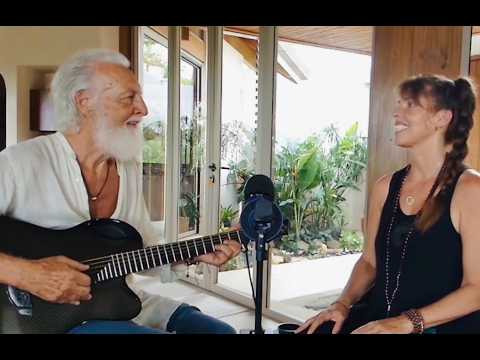
This live kirtan recording features Miten and Deva Premal performing the "Om Namo Narayana" chant in Slovenia (June 2008), accompanied by Manose on the bansuri (bamboo flute). The performance captures the essence of devotional call-and-response chanting, where the mantra invokes the divine name Narayana while the bansuri creates a meditative sonic landscape. Kirtan is a participatory singing practice rooted in bhakti (devotional) yoga traditions, designed to open the heart and create collective spiritual experience through repetition and presence.
What Is the Om Namo Narayana Mantra?
The mantra chanted throughout this concert—"Om Namo Narayana"—combines three essential Sanskrit elements. "Om" (ॐ) is the primordial sound of creation and consciousness itself, considered the vibration from which all existence emerges. "Namo" means "I bow" or "I surrender," expressing reverence and humility. "Narayana" (नारायण) refers to the divine sustainer of the universe, often identified with Vishnu in Hindu philosophy, representing both transcendent reality and the divine that dwells within all beings.
Together, the mantra translates roughly as "I bow to the divine source of all existence." It is not sung as intellectual understanding but as a direct invocation—a calling forth of sacred presence through sound. The repetition of these syllables, called japa or kirtan when done in group settings, is believed to attune the nervous system to higher frequencies of consciousness and dissolve the boundary between the chanter and the divine.
How Does Kirtan Create a Meditative State?
Kirtan operates through the principle of nada yoga—the yoga of sound. When a mantra is sung repeatedly, either individually or in a group, it creates rhythmic patterns that calm the thinking mind. The Sanskrit syllables have specific vibrational qualities: the "om" sound vibrates at the crown of the head, while "namo" and "narayana" create resonances through the chest and heart center.
In this recorded performance, Miten leads the chant with Deva Premal's voice providing harmonic depth and responsorial lines. This call-and-response structure—fundamental to kirtan practice—engages both hemispheres of the brain. The leader sings a phrase, and the group (or in a recording, the layered voices) responds. This back-and-forth rhythm synchronizes breath, heartbeat, and neural oscillation, creating a state of relaxed alertness similar to meditation but with the additional benefit of emotional engagement and heart opening.
Manose's bansuri accompaniment serves a crucial function here. The flute is intrinsically linked to divine love in Indian tradition (Krishna is traditionally depicted playing the bansuri), and its sound creates a harmonic scaffold that supports the mantra. The flute's natural frequencies resonate with the vocal chant, amplifying the vibrational effect and drawing practitioners deeper into inner stillness.
What Happens to the Body and Mind During Mantra Repetition?
Modern neuroscience increasingly validates what contemplative traditions have known for millennia: mantra repetition produces measurable shifts in brain activity and physiology. The rhythmic chanting of Sanskrit syllables has been shown to:
- Activate the parasympathetic nervous system—the "rest and digest" branch that counteracts stress responses. The sustained vocal production and breathing patterns inherent in kirtan naturally slow heart rate and lower cortisol.
- Increase coherence between brain regions—particularly the prefrontal cortex (rational mind) and limbic system (emotional center), reducing the sense of fragmentation or inner conflict.
- Release endogenous opioids—the body's own feel-good chemicals. Chanting has been shown to trigger release of these natural neurotransmitters, creating a sense of peace and connection without external substances.
- Slow brain-wave frequency—moving from beta (waking consciousness) toward alpha and theta states (meditative and dreamlike consciousness), where insight and intuitive knowing arise.
Beyond neurobiology, practitioners report that after 20-30 minutes of sustained kirtan, the sense of individual separation often dissolves. The "me" who is singing becomes less distinct; instead, there is just the singing happening, the breath flowing, the sound arising. This state of merger between subject and object is sometimes called samadhi in yoga terminology—a non-dual awareness where the observer and observed are recognized as one.
Why Is the Bansuri Essential to This Kirtan?
The bansuri (bamboo flute) is not mere accompaniment in this live concert—it is a voice of the divine masculine principle in Hindu philosophy. In the Bhagavad Gita and the Krishna legends, the flute represents the call of the beloved (Krishna) drawing the soul toward union. When Manose plays the bansuri alongside the vocal chanting, he creates a duet between the masculine and feminine aspects of divinity: the penetrating clarity of the flute meeting the fullness of the human voice.
Acoustically, the bansuri's natural overtones harmonize with Sanskrit vowels and consonants, creating a unified sound field that feels less like music and more like a living presence. The flute breathes with the singers, rises and falls with the mantra's melodic contours, and at moments seems to anticipate or echo the vocal line. This interplay between voice and flute creates a sense of dialogue—as if the divine is responding to the devotee's call through the instrument itself.
What Role Does Repetition Play in Bhakti Practice?
Kirtan is grounded in bhakti, the yoga of devotion and love. Unlike paths that rely on intellectual understanding or extreme physical discipline, bhakti uses emotion and relationship as the vehicle for spiritual transformation. Repetition in kirtan is not boring or mechanical—it is deepening.
Each time "Om Namo Narayana" is sung, a new layer unfolds. First, the mind grasps the literal meaning. With continued repetition, intellectual understanding falls away and the mantra begins to sing itself through the body. The breath carries the sound; the blood pulses with it. Emotional residue—stored grief, fear, or longing—may surface and dissolve in the sound. The heart, which has been defended or contracted, begins to open. The individual ego, which experiences itself as separate, recognizes itself in the infinite.
This is why traditional kirtan circles can last for hours. There is no "end point" or "completion"—the practice unfolds naturally, moment by moment, with each repetition peeling back another layer of conditioning until only pure presence remains.
How Does This 2008 Slovenia Performance Differ From Studio Recordings?
This is live kirtan, which carries different qualities than a produced album. A live performance captures the organic unfolding of the mantra in real time, without overdubs or edits. There is a vulnerability and immediacy: if a voice cracks, if the rhythm shifts, if emotional depth breaks through, it remains in the recording. This rawness is often more potent than polished studio production because it demonstrates that kirtan is not about technical perfection—it is about sincere offering.
The presence of a live audience also shifts the energetic field. When many hearts and minds synchronize around a single mantra, the collective resonance amplifies. Neuroscientist call this "entrainment"—the tendency of oscillating systems to synchronize. Each person in the circle influences every other person; the unified intention creates a field of coherence that individual practice alone may not reach.
Where to Go From Here
If this kirtan recording resonates with you, consider engaging with the practice directly. Deva Premal and Miten offer recordings, tours, and an app (Gayatri Sangha) dedicated to kirtan and mantra practice. You can learn more at devapremalmiten.com, where you will find information on their music, upcoming tours, and resources for beginning your own practice.
To begin a kirtan practice yourself, start with 10-15 minutes of mantra repetition daily. You can chant silently, in a whisper, or aloud—all forms are effective. Allow the sound to find its own natural rhythm and melody. Notice what arises in the body, emotions, and mind without judgment. Over time, the practice deepens, and you may discover what countless devotional practitioners have: that the divine is not remote or abstract, but present in every breath, every heartbeat, every sound.